Evidence and Outcomes
Outcomes of Trauma-Informed Intervention Programmes
The research is clear.
The outcomes framework is rigorous.
TRIUMPH RECLAIM is the only programme in this commissioning space built on a convergent body of evidence from trauma science, employment support research, and public health policy simultaneously. The programme is co-led by Victoria Taylor (trauma specialism) and Stephanie Brown (chronic illness specialism) , two directors whose lived and professional expertise spans both dimensions of this population's barriers. No other programme addresses all three. This page sets out the evidence base and the outcomes framework that demonstrates it.
DWP-aligned · HMRC RTI-verified · 13 and 26 week sustained outcomes · Full cost analysis available
The Research Base
What the Evidence Tells Us
The four pillars of the evidence base each address a different dimension of the challenge. Together they make the case not just for trauma-informed employment support, but for this specific design: sequential, relational, long enough, and human enough.
"Trauma disrupts goal-directed behaviour. Employment interventions that do not first address physiological safety produce short-lived or no outcomes."
NHS Talking Therapies, 2022
This finding is the evidential foundation for the Readiness phase. It explains why TRIUMPH RECLAIM cannot begin with employment support. It must begin with safety.
Any programme that skips this step with this population is not just less effective. It is contraindicated by the neuroscience.
When safety comes first, everything else becomes possible.
"Women with chronic conditions are 2.3 times more likely to exit the labour market permanently following a health event."
IPPR, 2024
This statistic names the scale of the problem TRIUMPH RECLAIM exists to address. Permanent labour market exit is not inevitable for this population. It is the result of insufficient support at the right time.
The 26-week duration of TRIUMPH RECLAIM is a direct response to this finding.
Permanent exit is not inevitable. It is the result of insufficient support at the right time.
"Employment outcomes for people with complex health and trauma histories improve significantly with relational continuity."
Lemos and Crane, 2023
Relational continuity (the same two associate practitioners present with each cohort across all seven phases) is not a design preference in TRIUMPH RECLAIM. It is an evidential requirement.
The programme is structured so that the same practitioner team is present from Readiness through to Mastery precisely because the research shows that relationship is the vehicle through which outcomes are achieved.
The same two faces. The same two voices. Every step of the way.
"Programmes including in-work support for a minimum of 12 weeks post-placement achieve significantly higher 26-week sustainability rates."
NICE Evidence Review, 2022
This finding is the evidence base for the Integration phase, the phase most programmes do not have at all. TRIUMPH RECLAIM does not withdraw support at job entry. It intensifies it.
The sustained employment outcomes the programme targets at 13 and 26 weeks are only achievable because of this design decision.
The programme does not end at job entry. It ends at mastery.
Outcomes Framework
What the Programme Measures
TRIUMPH RECLAIM uses a DWP-aligned outcomes framework. Employment starts are verified through HMRC Real Time Information. Sustained employment is measured at 13 weeks and 26 weeks post-placement. Every outcome is evidenced, documented, and reported to commissioners in both an interim report at week 30 and a final report at programme end.
| Outcome Measure | Target | How It Is Measured | When Reported |
|---|---|---|---|
| Programme Retention | 85% Phase R to Phase I | Attendance records and phase registration | Interim report (week 30) and final report |
| Employment or Self-Employment Rate | 60% by Phase A end | Employment start confirmations, HMRC RTI, trading evidence | Interim report (week 30) |
| Sustained Employment at 13 Weeks | 70% of employment starts | HMRC Real Time Information cross-referenced with programme records | Final report and ongoing milestone tracking |
| Sustained Employment at 26 Weeks | 65% of employment starts | HMRC RTI, payslip evidence where required, employer confirmation | Final report, tracked up to 12 months post-graduation |
| Active Engagement Rate | 100% at all times | IAP status: employed, self-employed, interviewing, or searching with a clear plan | Continuous, reported at both interim and final stages |
| Cost Per Participant | £13,000 fully loaded | Total programme cost divided by cohort size | Final report with full cost analysis |
Beyond Employment Outcomes
The Distance Travelled Data
Employment outcomes are not the only measure of impact. TRIUMPH RECLAIM tracks participant transformation across seven TRIUMPH pillars throughout the programme.
This distance travelled data demonstrates measurable change even in participants who have not yet reached employment, and represents significant value to commissioners and to the broader public purse.
T
Trust
Rebuilding trust in self, body, and others. The foundation without which nothing else holds.
She learns to trust her own judgement again.
R
Reclamation
Moving from victim to protagonist. From patient to agent of her own life.
participant history becomes a source of strength, not shame.
I
Identity
Who she is. Not what happened to her, not what her body has done.
She knows who she is, independent of her history.
U
Boundaries
The capacity to protect what she needs, in the workplace and beyond.
She stops saying yes when she means no.
M
Energy
Understanding and managing energy as the asset it is, not the enemy it has felt like.
She works with her body, not against it.
P
Purpose
Meaningful work that aligns with her values and her actual capacity.
She knows what she is working toward and why.
H
Health
Physical, mental, and relational health as integrated and inseparable.
She is not managing her health. She is living alongside it.
Non-employment outcomes captured through the TRIUMPH pillar data, including improved health self-management, reduced crisis service usage, increased social participation, and improved family functioning, and represent significant value to commissioners and to the broader public system.
These outcomes are documented in every final report and tell the story of transformation even before the employment headline is achieved.
Value for Money
The Cost Analysis
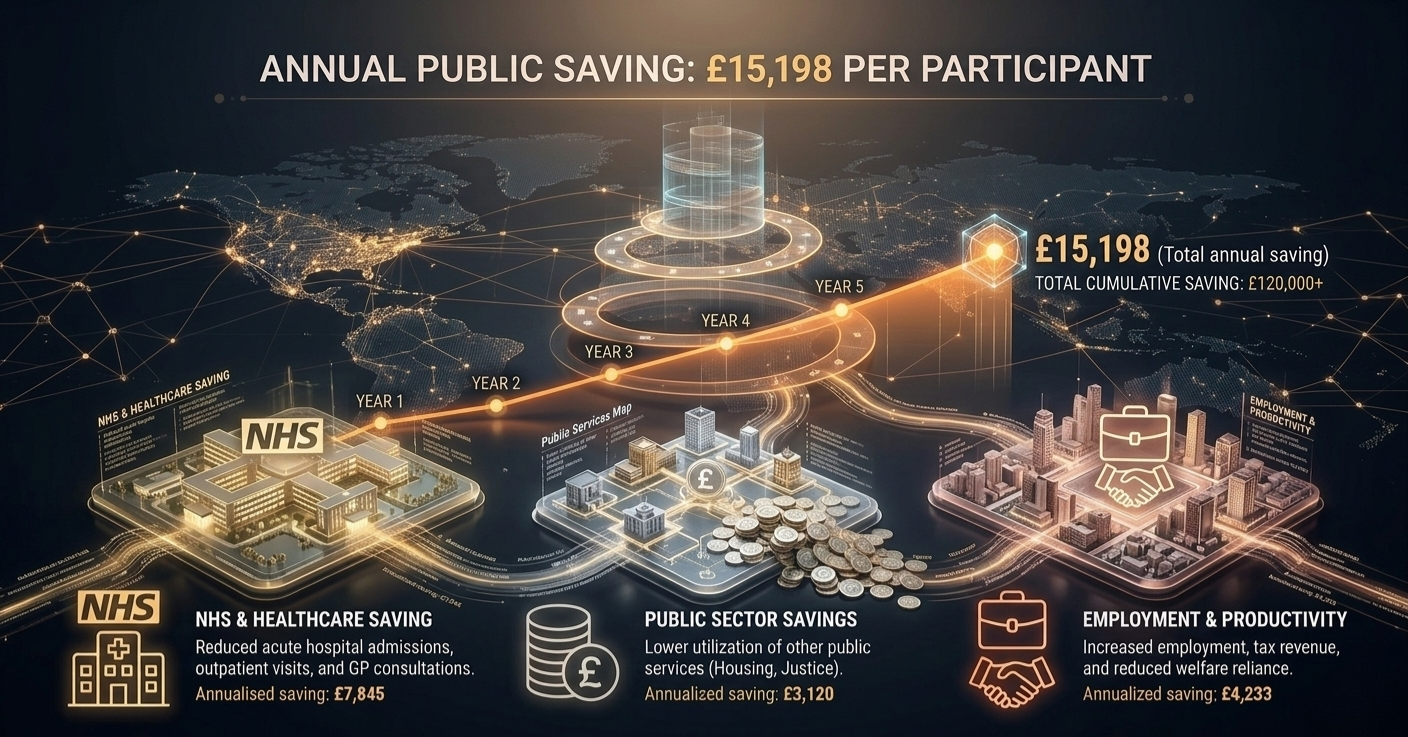
TRIUMPH RECLAIM delivers measurable value for money at every level of the cost analysis. At £13,000 per participant fully loaded, the programme cost is recovered within eleven months through reduced NHS usage, benefits savings, and tax revenue from sustained employment.
11
Month payback period
Programme cost recovered through public savings alone
117%
Year one return on investment
The programme generates more in public savings within twelve months than the total cost of delivery
351%
Three year return on investment
Per sustained participant, compounding annually through continued employment and reduced service usage
The Health Economics Case
Each sustained participant generates £15,200 in annual public savings through reduced NHS usage, reduced benefits dependency, and tax revenue from sustained employment.
Across a cohort of twelve with projected sustained employment rates applied, this equates to £182,400 in annual public savings per cohort.
What £13,000 Covers
The cost per participant includes lead practitioner delivery, associate practitioner support, programme management, assessment materials, venue and technology, clinical supervision, evaluation, and contingency.
Cheaper programmes that produce lower sustained outcomes cost the public purse more over time, not less.
Seen enough to want a conversation?
The scoping call is sixty minutes. A direct conversation about your population, your contract requirements, and whether TRIUMPH RECLAIM is the right fit. There are women in your area right now sitting outside the labour market who this evidence was written about. The question is whether your area will have this programme or not.
Book a Scoping Call Request Programme Overview
TRIUMPH RECLAIM is a programme by Mindset + Mastery, founded by Victoria Taylor and Stephanie Brown. We work with women experiencing economic inactivity due to chronic illness, trauma, or both.
Email: [email protected]
Phone: 0208 058 4508
TRIUMPH RECLAIM is a structured employment support programme delivered by Mindset + Mastery Ltd. It is not a regulated health or therapeutic service and does not constitute clinical treatment.
Mindset + Mastery Ltd operates a safeguarding policy for all programme participants. Details available on request.
Mindset + Mastery Ltd · Registered in England and Wales · Company No. 16890773 · Registered Office: 20 Wenlock Road, London, England, N1 7GU
Also part of the Mindset + Mastery ecosystem: victoriataylorspeaks.com | stephaniebrowninspires.com | mindsetplusmastery.com | visiblyher.org
Privacy Policy · Terms of Use · Safeguarding Policy
TRIUMPH RECLAIM® is a registered trademark of Mindset + Mastery Ltd · © 2026


TRIUMPH RECLAIM® is a registered trademark of Mindset + Mastery · © 2026