The Programme
Structured Trauma Recovery Programme
A Programme Built for Her.
Precisely.
The women TRIUMPH RECLAIM serves are not hard to help. They have been failed by provision designed for someone else. There is no other programme in the UK that addresses trauma, chronic illness, and employment together in a single structured model. This one does.
Seven phases · 26 weeks · DWP-aligned outcomes · Full governance suite available
Who This Programme Serves
Built for Her Specifically
Standard employment support was not designed for this population. These women have been assessed by frameworks that did not account for their complexity. They have been referred into provision that moved too fast, withdrew too soon, or treated their chronic health condition or trauma history as a barrier rather than as the context in which employment support must be delivered.
Many have already completed therapy. They understand their patterns. They have done significant inner work. What they have not had is a programme that accounts for their whole reality.
TRIUMPH RECLAIM was designed for women who are:
Economically inactive due to chronic health conditions, trauma histories, or both
Capable of sustained employment with the right support
Who have not yet found that support anywhere else
Each cohort runs with a maximum of twelve participants, ensuring every woman receives genuine individual attention alongside a group built on real trust. On the other side of 26 weeks, she is not the same woman who walked in. She knows it. And so do the people around her.
The Seven Phases of RECLAIM
The Seven Phases
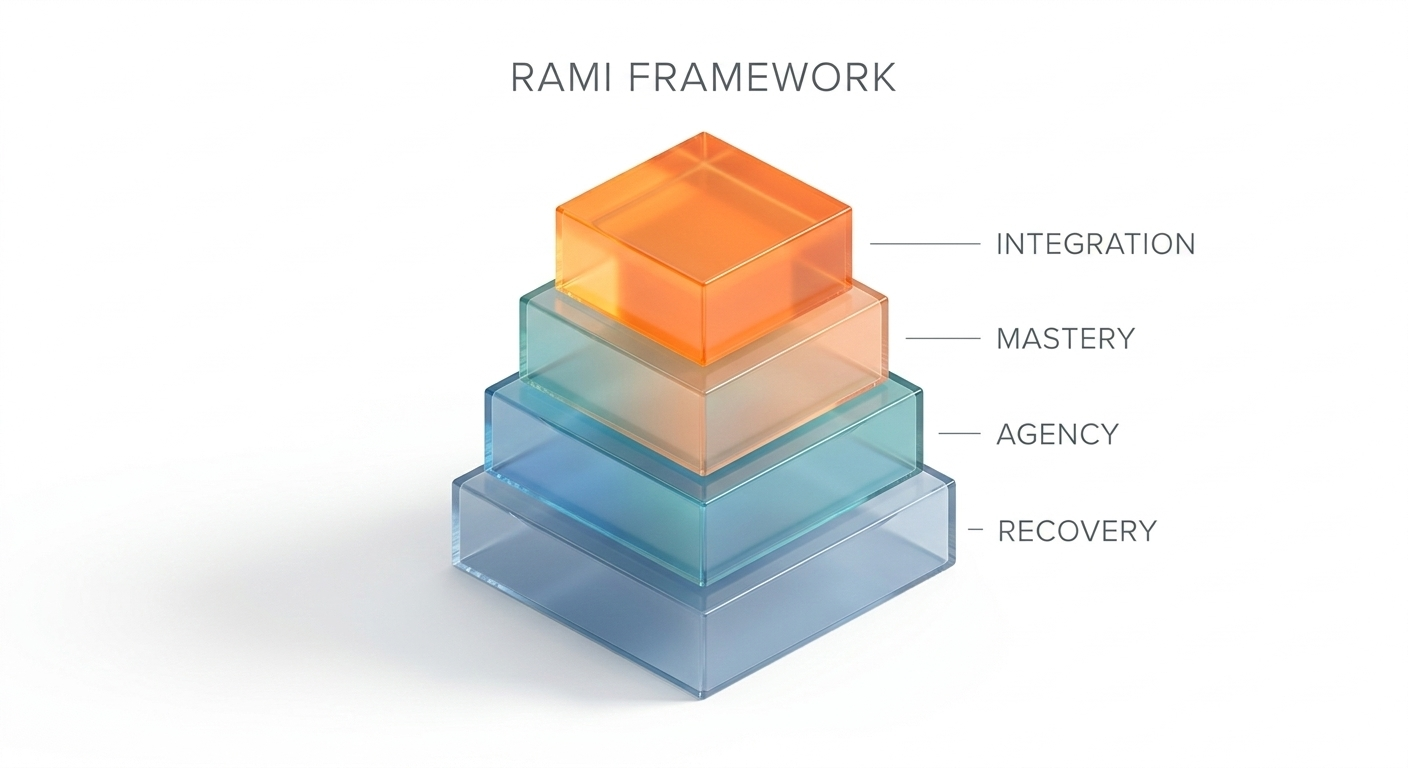
TRIUMPH RECLAIM is structured around seven sequential phases. Each phase creates the condition the next phase requires. Remove one phase and the next loses its foundation. Compress the timeline and the outcomes compress with it.
Phase Focus
Readiness
Psychological safety and trauma-informed assessment.
Before a woman can engage with employment support she needs to feel safe enough to engage at all. This phase covers trauma screening, establishing trust with the practitioners, identifying barriers with clarity, and building the psychological foundation the programme requires.
Evidence basis: Polyvagal theory (Porges) confirms that goal-directed behaviour is neurologically inaccessible when the nervous system is in threat response. TRIUMPH baseline assessment across all seven pillars is completed in this phase.
Outcome: She is safe. She is seen. She is ready to begin.
Phase Focus
Empowerment
Identity, narrative, and self-understanding.
participant history stops being something that happened to her and starts being the source of her understanding of herself. Identity work, values clarification, and beginning to separate who she is from what she has been through.
Evidence basis: Trauma-informed practice principles (SAMHSA). This phase produces the documented therapeutic dip, a temporary worsening that practitioners are trained to distinguish from clinical deterioration. First distance travelled data is captured here.
Outcome: She knows her strengths. She knows what she is capable of. Independent of her history.
Phase Focus
Capacity
Energy management and sustainable foundations.
Practical energy management, health navigation alongside employment goals, and building the daily structures that make sustained work possible for someone managing chronic illness or trauma responses.
Evidence basis: Energy envelope theory and chronic illness as systemic barrier. This phase addresses the IPPR finding that women with chronic conditions are 2.3 times more likely to exit the labour market permanently. Equality Act 2010 reasonable adjustments framework is introduced here.
Outcome: She understands her capacity honestly. She has practical systems to protect and expand it.
Phase Focus
Launch
Skills development and employment planning.
CV work, employment planning, and skills development, all grounded in everything the previous three phases have built. Not a generic CV. Her CV, reflecting her actual strengths and her honest capacity.
Operational note: Individual Action Plans are co-created in this phase. Employment targets are set collaboratively, not imposed. DiSC personality profiling is applied to match participants with communication strategies for employer engagement.
Outcome: She is genuinely ready. Not pushed. Ready.
Phase Focus
Action
Supported job searching and employer engagement.
Active job searching, interview preparation, and employer engagement with her associate practitioner team alongside her throughout. Volunteering, work experience, and education are also valid outcomes at this stage.
Commissioner reporting: Employment starts are recorded and verified against HMRC RTI from this phase. The interim outcome report is produced covering retention, employment starts, and projected final outcomes.
Outcome: First employment or meaningful employment-adjacent activity, on her terms.
Phase Focus
Integration
In-work support and workplace navigation.
The phase most programmes do not have at all. She is in work or close to it. Now the support intensifies rather than withdrawing. Managing the workplace with a trauma history or chronic health condition is its own skill set.
Evidence basis: NICE Evidence Review (2022) confirms that in-work support for a minimum of 12 weeks post-placement achieves significantly higher 26-week sustainability rates. The 13-week sustained employment milestone is tracked and evidenced in this phase.
Outcome: Not just employed. Stable in employment, with the tools and the support to stay.
Phase Focus
Mastery
Self-direction, future planning, and sustained achievement.
She is employed, she is stable, and now she is planning her future on her own terms. Career development, longer-term goals, and the transition from supported participant to self-directed professional.
Commissioner reporting: The 26-week sustained employment milestone is tracked and evidenced in this phase. Final TRIUMPH pillar re-scoring produces the complete transformation trajectory. The comprehensive final outcome report is produced at programme end.
Outcome: A woman who has moved from surviving her circumstances to directing her future.
The Methodology
The RECLAIM Methodology
Trauma-informed practice is not a technique. It is a way of designing every element of a programme, the pace, the language, the assessment approach, the relationship between practitioner and participant, and the structure of each phase, around the reality of how trauma lives in the body and affects the capacity to engage.
The safety-first approach is not optional for this population. Polyvagal theory tells us that goal-directed behaviour, including employment-focused activity, is neurologically impossible when the body is in a state of physiological unsafety. This is why Readiness is the first phase.
This is not a programme that will leave your referrals unsupported at the moments that matter most. The methodology is designed to hold women carefully, and to know when to hold tighter.
The evidence base that underpins TRIUMPH RECLAIM is convergent rather than drawn from any single discipline. Trauma science, employment support research, chronic illness management, and public health policy each contribute to the design.
No single discipline holds the whole picture for a population whose needs span the medical, the structural, and the deeply personal. The methodology reflects that complexity without being overwhelmed by it.
Every session, every interaction, and every decision within TRIUMPH RECLAIM is grounded in the understanding that the body must feel safe before the mind can plan.
Theory of Change
Theory of Change
TRIUMPH RECLAIM operates on a clear and evidenced theory of change. The logic is sequential and each step is necessary for the next.
Step 1
Psychological Safety
The body feels safe enough to engage.
Step 2
Capacity Building
Energy and daily structure become sustainable.
Step 3
Skills Development
Employment-ready skills built on solid ground.
Step 4
Supported Entry
First employment with practitioners alongside.
Outcome
Sustained Employment
Stable, self-directed, and lasting.
The final outcome, sustained employment, is defined as employment maintained at 13 weeks and 26 weeks post-placement. The in-work support delivered during the Integration phase is the single most significant factor in achieving that definition. This is why the programme does not end at job entry. It ends at mastery. No other programme in this commissioning space includes what happens between job entry and sustained employment. That is the gap where everything is lost. TRIUMPH RECLAIM is the only programme that closes it.
There is nothing else like this.
One trauma specialism. One chronic illness specialism. Seven sequential phases. The only programme in the UK built this way, for this population, with this level of evidence behind it.
If you are a commissioner, a referral partner, or a woman who recognises herself in this page, the next step is the same. One conversation. No commitment. Everything you need to decide.
Start the Conversation Request Programme Overview
TRIUMPH RECLAIM is a programme by Mindset + Mastery, founded by Victoria Taylor and Stephanie Brown. We work with women experiencing economic inactivity due to chronic illness, trauma, or both.
Email: [email protected]
Phone: 0208 058 4508
TRIUMPH RECLAIM is a structured employment support programme delivered by Mindset + Mastery Ltd. It is not a regulated health or therapeutic service and does not constitute clinical treatment.
Mindset + Mastery Ltd operates a safeguarding policy for all programme participants. Details available on request.
Mindset + Mastery Ltd · Registered in England and Wales · Company No. 16890773 · Registered Office: 20 Wenlock Road, London, England, N1 7GU
Also part of the Mindset + Mastery ecosystem: victoriataylorspeaks.com | stephaniebrowninspires.com | mindsetplusmastery.com | visiblyher.org
Privacy Policy · Terms of Use · Safeguarding Policy
TRIUMPH RECLAIM® is a registered trademark of Mindset + Mastery Ltd · © 2026


TRIUMPH RECLAIM® is a registered trademark of Mindset + Mastery · © 2026